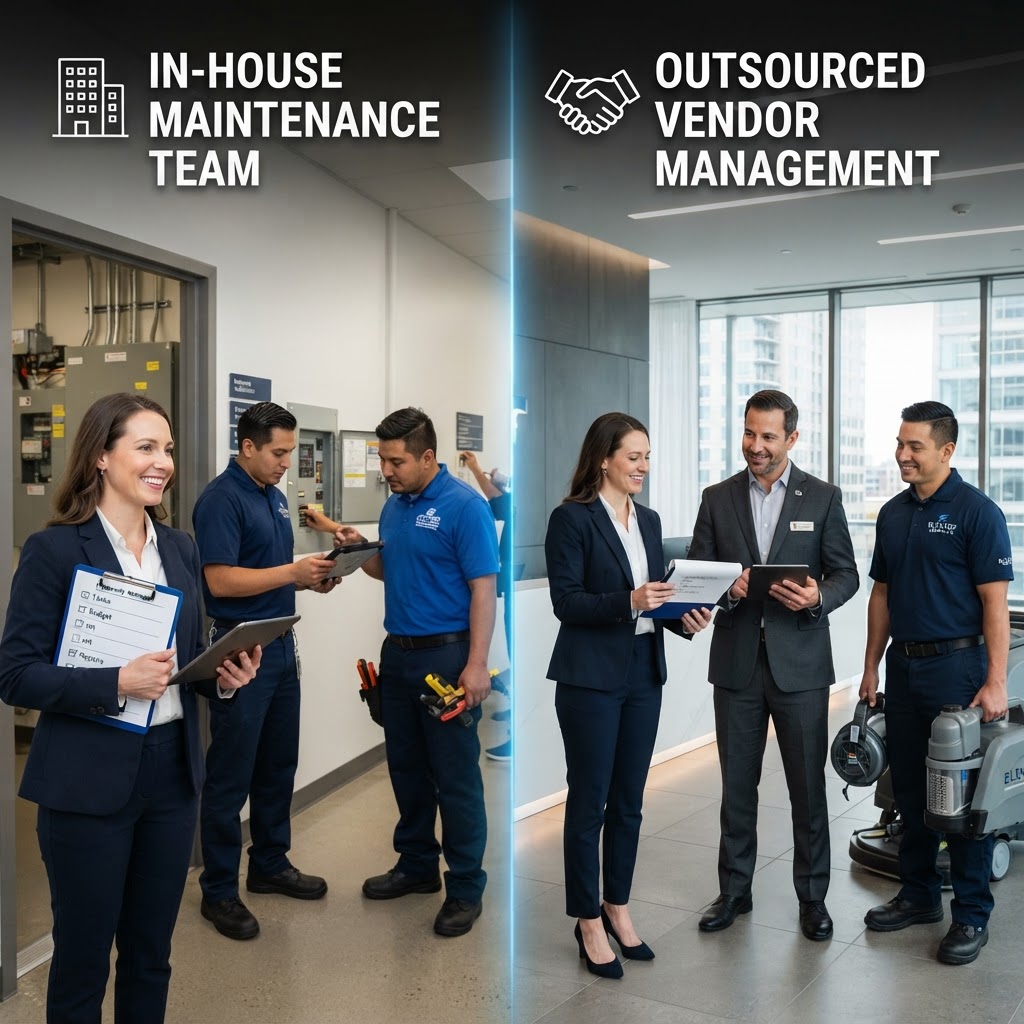
In-House Maintenance vs Outsourced Vendor Management
Property owners and managers face a fundamental decision: maintain an in-house maintenance team or outsource to a vendor management platform. Each approach has distinct advantages and trade-offs in cost, control, scalability, and quality.
In-House Maintenance Teams
Advantages
Direct Control — You manage schedules, priorities, and quality standards directly. Maintenance staff respond to your priorities without the delays of a vendor dispatch process.
Familiarity with Properties — In-house staff know the quirks of each building, the history of past repairs, and the preferences of tenants and management.
Faster Response for Routine Issues — For properties with consistent maintenance volume, having staff on-site means immediate response to common issues.
No Markup — You pay labor and materials directly, without the overhead or profit margin of a vendor management company.
Disadvantages
Fixed Costs — Salaries, benefits, vehicles, and equipment are fixed costs regardless of maintenance volume. During slow periods, you are paying for idle capacity.
Limited Expertise — A small in-house team cannot cover every trade. You still need outside contractors for HVAC, electrical, plumbing, and roofing.
Scalability Challenges — Adding properties means hiring, training, and equipping more staff. Scaling down is painful and disruptive.
Compliance and Liability — You manage licensing, insurance, background checks, and workers compensation for all staff.
Outsourced Vendor Management
Advantages
Variable Costs — You pay for work performed, not idle time. Costs scale with your actual maintenance needs.
Multi-Trade Coverage — A vendor management platform provides access to vetted contractors across every trade and service category.
Scalability — Adding properties or markets does not require hiring. The vendor network expands to meet demand.
Performance Tracking — Platforms like Auxi track quality scores, response times, and cost data across all vendors, enabling data-driven decisions.
Reduced Administrative Burden — Work order dispatch, invoicing, compliance tracking, and vendor vetting are handled by the platform.
Disadvantages
Less Direct Control — You rely on the platform to dispatch and supervise vendors, which can feel like a loss of control for managers accustomed to directing their own staff.
Platform Fees or Markup — Vendor management platforms charge fees or apply markup to vendor pricing. However, negotiated volume pricing often offsets these costs.
Onboarding Time — Transitioning from in-house to outsourced requires onboarding, data migration, and process adjustment.
Which Approach Is Right for You?
Choose In-House If:
- You manage a single large property with consistent maintenance volume
- You need on-site staff for security or rapid response
- Your property has specialized systems requiring dedicated expertise
- You have the administrative capacity to manage staff and compliance
Choose Outsourced If:
- You manage multiple properties across different locations
- Your maintenance volume fluctuates seasonally
- You need multiple trade specialties
- You want performance data and cost analytics
- You are growing your portfolio and need scalability
Choose a Hybrid Approach If:
- You have a small in-house team for routine work but outsource specialized trades
- You use in-house staff for high-volume properties and outsourced vendors for satellite locations
The Bottom Line
For most property portfolios over 10-15 properties, outsourced vendor management delivers better cost efficiency, scalability, and quality consistency. The key is choosing a platform that provides transparent pricing, performance tracking, and a vetted vendor network.