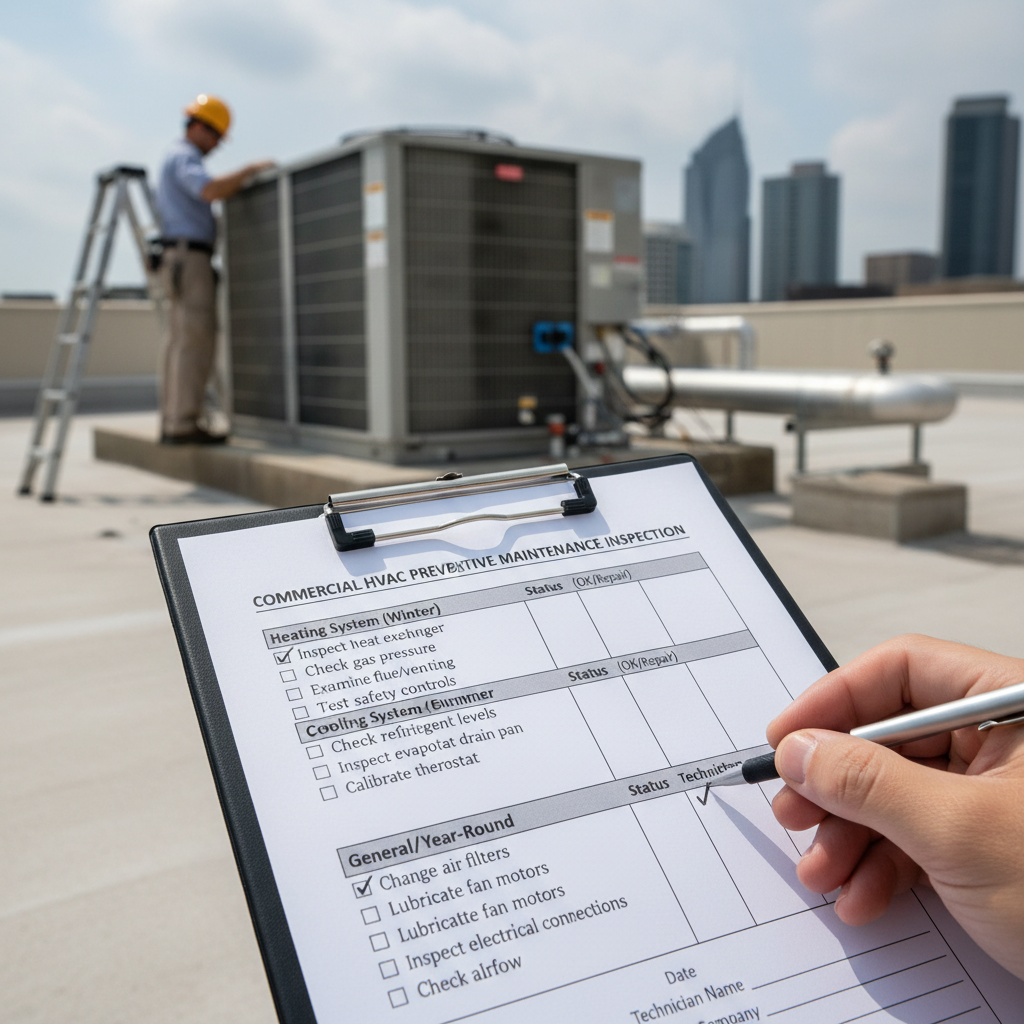
HVAC Preventive Maintenance Checklist for Property Managers
As a property manager, few systems are as critical—or as expensive to replace—as your HVAC equipment. A well-executed preventive maintenance program can extend equipment life by 5-10 years, reduce energy consumption by up to 40%, and dramatically cut emergency repair costs.
Why HVAC Preventive Maintenance Matters
According to the Department of Energy, HVAC systems account for 40-60% of a commercial building's energy usage. Neglected systems work harder, consume more energy, and fail more frequently—often during peak demand periods when emergency repair rates are highest.
Seasonal Maintenance Checklist
Spring (Cooling System Prep)
- Inspect and clean condenser coils — Dirty coils reduce efficiency by up to 30%
- Check refrigerant levels — Low refrigerant indicates leaks and reduces cooling capacity
- Replace air filters — Clogged filters force the system to work harder and reduce indoor air quality
- Inspect electrical connections — Loose connections cause system failures and fire hazards
- Test thermostat operation — Ensure accurate temperature control and scheduling
- Clean condensate drain lines — Clogged drains cause water damage and mold growth
- Lubricate motors and bearings — Reduces friction and extends motor life
Summer (Peak Cooling Season)
- Monitor system performance — Track energy usage for anomalies
- Replace filters monthly — High cooling loads mean faster filter saturation
- Inspect ductwork for leaks — Leaky ducts waste 20-30% of conditioned air
- Check outdoor unit clearance — Ensure vegetation doesn't block airflow
- Verify proper drainage — Summer humidity increases condensate volume
Fall (Heating System Prep)
- Inspect heat exchanger — Cracks allow carbon monoxide to enter living spaces
- Check burners and ignition — Ensures safe and efficient heating operation
- Test safety controls — Including limit switches and flame sensors
- Inspect flue system — Ensures proper ventilation of combustion gases
- Replace air filters — Heating season demands clean airflow
- Check belts and pulleys — Worn belts cause unexpected breakdowns
- Test carbon monoxide detectors — Critical safety for gas heating systems
Winter (Peak Heating Season)
- Monitor system cycling — Short cycling indicates sizing or thermostat issues
- Check for ice dams on roofs — Can damage HVAC components and structures
- Inspect pipe insulation — Prevents freezing and energy loss
- Replace filters monthly — Heating loads accelerate filter saturation
The ROI of Preventive Maintenance
| Metric | Without PM Program | With PM Program | |---|---|---| | Average equipment lifespan | 10-12 years | 15-20 years | | Emergency repairs per year | 4-6 | 1-2 | | Energy costs | Baseline | 20-40% lower | | Tenant complaints | Frequent | Minimal |
Common HVAC Problems in Multifamily Properties
1. Uneven Heating and Cooling
Often caused by poor duct design, inadequate insulation, or undersized equipment. A professional assessment can identify the root cause.
2. Refrigerant Leaks
Low refrigerant reduces efficiency and can damage compressors. Annual leak checks catch problems early.
3. Dirty Coils
Evaporator and condenser coils accumulate debris over time. Annual cleaning restores efficiency and prevents premature failure.
4. Thermostat Issues
Faulty thermostats cause comfort complaints and energy waste. Upgrade to programmable or smart thermostats for better control.
Building a Maintenance Schedule
Create a master calendar that tracks:
- Filter replacement dates for each unit
- Seasonal inspection windows (spring and fall)
- Equipment age and replacement projections
- Warranty expiration dates
- Service vendor assignments
Documentation Requirements
Maintain detailed records for each HVAC unit:
- Installation date and specifications
- Filter size and replacement interval
- Repair history and parts replaced
- Energy consumption baseline and trends
- Inspection reports and photos
When to Repair vs. Replace
Use the $5,000 rule: multiply the repair cost by the equipment's age. If the result exceeds $5,000, replacement is typically more economical.
Example: A $600 repair on a 10-year-old unit = $6,000 → Replace.
How Auxi Services Helps
Our nationwide vendor network includes licensed HVAC professionals who can:
- Perform seasonal preventive maintenance across your entire portfolio
- Provide emergency repairs with sub-2-hour response times
- Track maintenance schedules and compliance through our platform
- Supply photo-verified completion reports for every service call
Conclusion
A structured HVAC preventive maintenance program is one of the highest-ROI investments a property manager can make. By following this seasonal checklist and leveraging a managed vendor network, you can reduce emergency repairs by 70%, extend equipment life by years, and keep tenants comfortable year-round.
Ready to implement a preventive maintenance program for your properties? Contact Auxi Services for a free consultation.