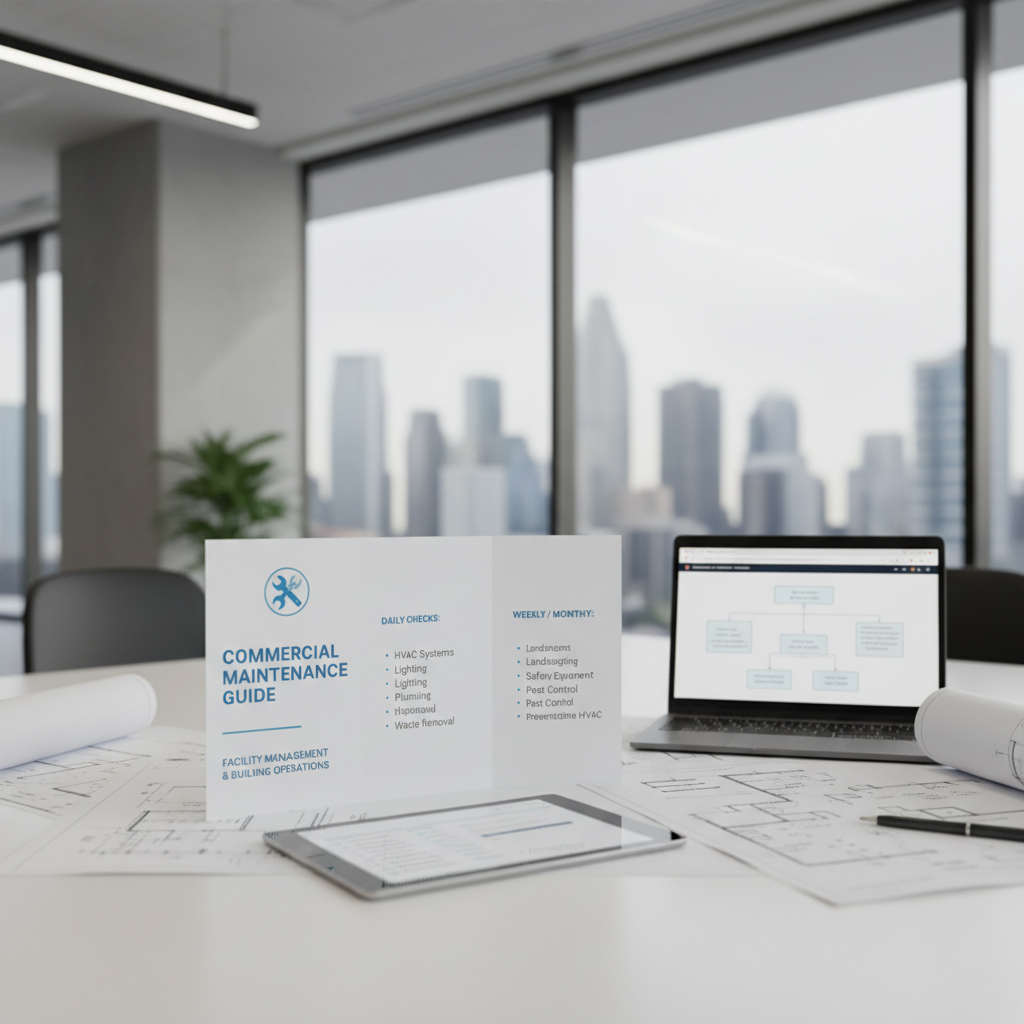
Commercial Property Maintenance: A Complete Guide for Facility Managers
Managing commercial property maintenance is one of the most complex responsibilities in facility management. Unlike residential properties, commercial buildings house businesses whose operations depend on minimal downtime—making maintenance delays directly impact tenant revenue and satisfaction.
What Is Commercial Property Maintenance?
Commercial property maintenance encompasses all activities required to keep a commercial building—office, retail, industrial, healthcare, or mixed-use—in optimal operating condition. This includes:
- Preventive maintenance: Scheduled inspections and servicing to prevent failures
- Corrective maintenance: Repairs in response to reported issues or failures
- Emergency maintenance: Urgent responses to safety hazards or operational disruptions
- Cosmetic maintenance: Upkeep of aesthetics—paint, landscaping, signage
Key Challenges in Commercial Maintenance
1. Tenant Coordination
Commercial tenants operate on business schedules. Maintenance must be scheduled around business hours, often requiring night or weekend work—a constraint that drives up labor costs and complicates vendor scheduling.
2. Compliance Requirements
Commercial buildings must meet stringent codes: ADA accessibility, fire safety, OSHA workplace standards, energy codes, and local building regulations. Each inspection or renovation must comply with the applicable standards.
3. Diverse Building Systems
A single commercial property may contain HVAC, electrical, plumbing, fire suppression, elevators, security systems, and specialized equipment. No single vendor can service all of them—requiring a coordinated network of licensed specialists.
4. Cost Control
Commercial maintenance budgets are scrutinized by ownership and corporate finance. Every dollar spent must be justified with clear ROI—a challenge when deferred maintenance is invisible until it becomes an emergency.
Building a Commercial Maintenance Strategy
Step 1: Conduct a Building Assessment
Document every system, its age, condition, and maintenance history. This baseline identifies:
- Equipment nearing end-of-life
- Systems with frequent failures
- Compliance gaps
- Energy efficiency opportunities
Step 2: Develop a Preventive Maintenance Schedule
Create a 12-month calendar covering:
- Monthly: Filter changes, visual inspections, safety checks
- Quarterly: System performance testing, lubrication, calibration
- Semi-annually: Seasonal HVAC prep, roof inspections, parking lot maintenance
- Annually: Comprehensive system audits, compliance inspections, major servicing
Step 3: Establish Vendor Relationships
Build relationships with licensed, insured vendors for each trade:
- HVAC technicians
- Electricians
- Plumbers
- Roofers
- Fire safety inspectors
- Elevator service providers
- General maintenance contractors
Step 4: Implement a Work Order System
Track every maintenance request from submission to completion:
- Request intake and triage
- Vendor assignment and scheduling
- Completion verification with photos
- Cost tracking and approval
- Tenant communication throughout
Step 5: Monitor and Optimize
Track key metrics monthly:
- Mean time to resolution: How quickly issues are resolved
- Preventive vs. reactive ratio: Should be 70/30 or better
- Cost per square foot: Benchmark against industry standards
- Tenant satisfaction scores: Direct feedback on service quality
- Emergency call frequency: Lower frequency = better preventive program
Common Commercial Maintenance Issues
HVAC System Failures
Commercial HVAC systems are the single largest maintenance expense. Signs of trouble:
- Inconsistent temperatures across zones
- Unusual noises or vibrations
- Rising energy bills without usage changes
- Frequent cycling on and off
Roof Leaks
Commercial flat roofs are prone to pooling water and membrane degradation. Annual inspections and prompt repair of small issues prevent major water damage.
Plumbing Problems
In commercial buildings, plumbing issues can disrupt operations across multiple tenant spaces. Common issues:
- Slow drains indicating blockages
- Water pressure fluctuations
- Hot water system failures
- Hidden leaks driving up water bills
Electrical System Issues
Aging electrical infrastructure in commercial buildings poses safety risks:
- Flickering lights indicating wiring problems
- Breaker trips from overloaded circuits
- Outlets that are warm to the touch
- Burning smells near panels or outlets
The Cost of Deferred Maintenance
| Deferral Period | Cost Multiplier | Example | |---|---|---| | 1 month | 1.5x | $200 repair becomes $300 | | 3 months | 2.5x | $200 repair becomes $500 | | 6 months | 4x | $200 repair becomes $800 emergency | | 12 months | 7x+ | $200 repair becomes $1,400+ replacement |
Technology in Commercial Maintenance
Modern facility management leverages technology to improve efficiency:
CMMS (Computerized Maintenance Management Systems)
Centralizes work orders, asset tracking, and maintenance scheduling. Enables data-driven decisions about repair vs. replace.
IoT Sensors
Monitor equipment health in real-time—vibration, temperature, pressure—alerting you to issues before they cause failures.
Mobile Work Order Management
Vendors receive assignments, document work, and submit invoices through mobile apps—reducing administrative overhead.
Photo-Verified Completions
Digital proof of completed work eliminates disputes and ensures quality standards.
Outsourcing vs. In-House Maintenance
In-House Pros
- Immediate availability for small tasks
- Deep knowledge of the building
- No vendor coordination overhead
In-House Cons
- Limited trade expertise
- Benefits and payroll costs
- Difficulty covering 24/7 emergencies
- No scalability for large projects
Outsourced Pros
- Access to licensed specialists for every trade
- Scalable—add or reduce services as needed
- 24/7 emergency coverage
- Competitive pricing through vendor networks
Outsourced Cons
- Requires vendor management
- Less building-specific knowledge
- Vendor quality varies
Best practice: A hybrid model—in-house staff for routine tasks, outsourced vendors for specialized trades and emergencies.
How Auxi Services Simplifies Commercial Maintenance
Auxi Services provides a managed marketplace that connects commercial property managers with pre-vetted, licensed vendors nationwide:
- Single point of contact: One platform for all trades—no more managing 15 different vendors
- Competitive pricing: Vendors bid on your work, ensuring market-rate pricing
- Quality assurance: Photo-verified completions, quality checklists, and performance ratings
- 24/7 emergency response: Sub-2-hour response times for urgent issues
- Transparent tracking: Real-time work order status, cost tracking, and completion reports
- Nationwide coverage: Consistent service quality across your entire portfolio
Conclusion
Effective commercial property maintenance requires a strategic approach: proactive scheduling, a reliable vendor network, transparent tracking, and data-driven decision-making. By investing in preventive maintenance and leveraging a managed platform like Auxi Services, facility managers can reduce emergency repairs by 60%, extend equipment life, and keep tenants satisfied.
Ready to modernize your commercial maintenance program? Contact Auxi Services for a free consultation.